
Understanding environmental impacts. Following the methodology.
The “resources SAVED by recycling” study quantifies the effects of the circular economy. It shows the calculated quantities of primary resources conserved and greenhouse gas emissions avoided through recycling compared with primary production.

Together with Fraunhofer UMSICHT, Interzero prepares the annual “resources SAVED by recycling” study. The scientifically grounded life cycle assessment quantifies recycling’s contribution to resource conservation and the reduction of greenhouse gas emissions. It shows the calculated quantities of primary resources conserved by keeping recyclable materials in the loop and the greenhouse gas emissions avoided compared with primary production. The study explains the differences between recycling and primary production and places their significance for the circular economy in context.
The 2025 results illustrate the calculated effects of the recycling activities assessed in the study. By keeping around 2 million tonnes of recyclable materials in the loop in Germany, Austria, Poland, Italy and Slovenia, Interzero achieved a calculated saving of more than 7.2 million tonnes of primary resources compared with primary production. At the same time, the company’s recycling activities avoided more than 900,000 tonnes of greenhouse gas emissions compared with primary production.


* DB, Integrated Interim Report 2025 | ** German Environment Agency, Environmental Cost Handbook – Methodological Convention 4.0
Crude oil conversion example
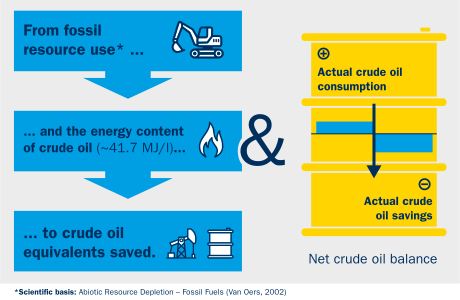
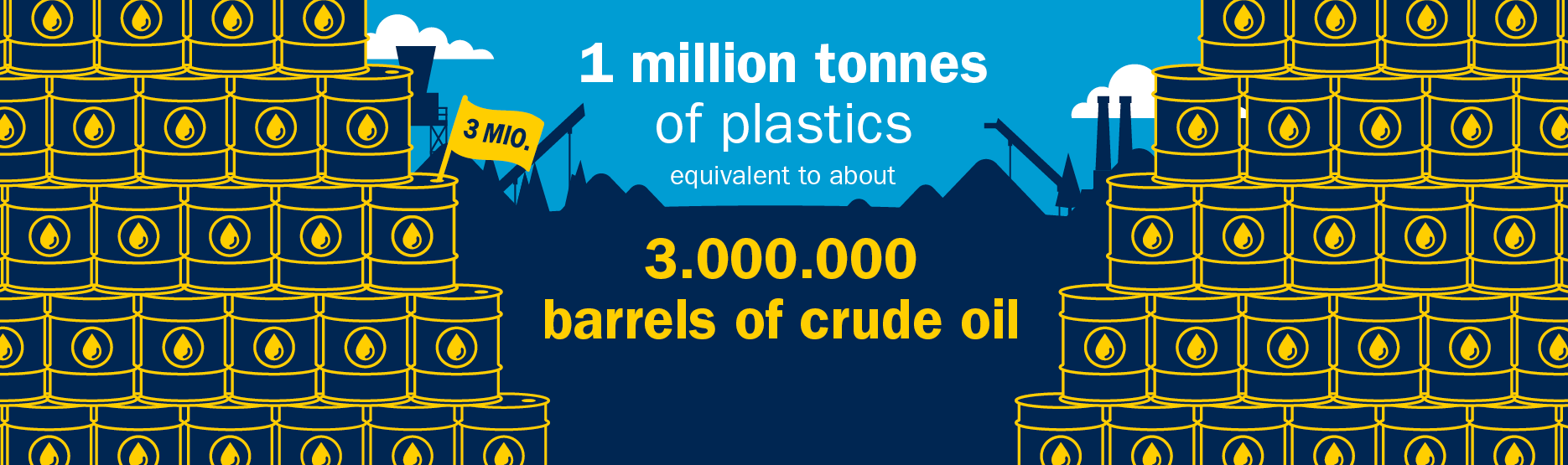
How can complex environmental impacts be communicated in an understandable way? The “resources SAVED by recycling” study uses illustrative conversion examples. For around one million tonnes of plastics kept in the loop in 2025, the calculated difference in fossil resource use compared with primary production corresponds to the energy content of approximately 3 million barrels of crude oil. This is equivalent to around 9.5 million 50-litre passenger-car fuel tank fill-ups.
The calculation is based on the scientific impact indicator “Abiotic Resource Depletion – Fossil Fuels”, which records the consumption of fossil resources such as crude oil, natural gas and coal throughout a product’s life cycle. Fraunhofer UMSICHT compares the energy required to manufacture plastics from primary raw materials with the energy required for plastics recycling. The calculated difference is then converted into an illustrative unit using the energy content of crude oil. This makes the calculation transparent, understandable and tangible.
How recycling contributes to resource conservation




Key Specialist Corporate Marketing