
Circular economy works: Interzero and Fraunhofer UMSICHT make impact visible

![[Translate to English - Englisch:]](/fileadmin/_processed_/e/4/csm_Screen_Sperrbildschirm_1920x1080px_90344d3eac.jpg "[Translate to English - Englisch:]")
[Translate to English - Englisch:]
Record temperatures across Europe, devastating wildfires and growing environmental pressures have made the effects of climate change impossible to ignore. At the same time, the need for effective and scalable solutions has never been greater.
One of these solutions is recycling. By replacing primary raw materials with secondary materials, recycling significantly reduces energy consumption, conserves natural resources and lowers greenhouse gas emissions. The effectiveness of this approach is confirmed by the “resources SAVED by recycling study”, which Interzero has conducted together with the renowned research institute Fraunhofer UMSICHT for nearly 20 years. Based on scientific life cycle assessment methodology, the study quantifies the environmental impact of Interzero’s recycling activities and makes the benefits of the circular economy measurable and transparent.
Climate and resource protection: results for 2025
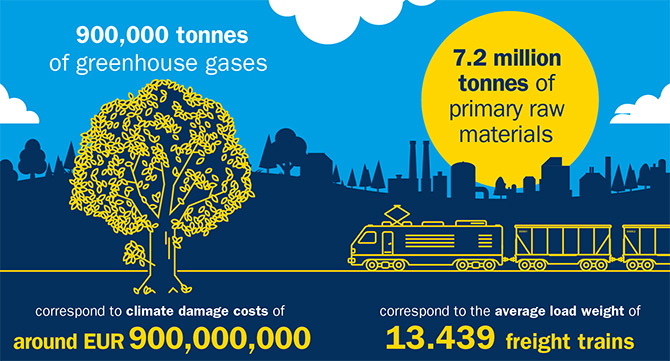
According to the latest study results, Interzero prevented more than 900,000 tonnes of greenhouse gas emissions in 2025 by keeping around 2 million tonnes of recyclable materials in circulation.
The environmental benefits also translate into significant economic value. Every tonne of emissions avoided helps reduce the costs associated with climate change. According to calculations based on the German Environment Agency’s Environmental Cost Handbook, the emissions savings achieved by Interzero and its customers in 2025 alone correspond to avoided climate-related costs of approximately €900 million when the interests of present and future generations are weighted equally. Even under a more conservative calculation model, the avoided costs exceed €300 million.*
These figures highlight an important reality: sustainability is not only an environmental responsibility. It also creates tangible economic value and contributes directly to a more resilient future.
Conserving resources through circularity
The positive impact extends far beyond climate protection. According to the study, Interzero’s recycling activities saved more than 7.2 million tonnes of primary resources in 2025. To put this into perspective, this corresponds to the average freight load of approximately 13,439 freight trains.** Against a backdrop of increasing demand for raw materials and growing pressure on global supply chains, the study underlines the crucial role of the circular economy in preserving finite resources and strengthening long-term resource security for industry.
Plastic recycling saves millions of barrels of crude oil
The calculations carried out by Fraunhofer UMSICHT are based on a systematic comparison between the production of primary raw materials and recycling processes. Using established life cycle assessment methods, environmental savings can be quantified in a scientifically robust and transparent manner.
One example is the conservation of crude oil through plastic recycling. To determine these savings, researchers compared the energy required for producing virgin plastics with the energy required for recycling plastic waste. The resulting energy savings were converted into crude oil equivalents, using a conversion factor of approximately 41.7 megajoules per litre of crude oil.
The result is remarkable: by recycling around 1 million tonnes of plastics in 2025, Interzero helped save approximately 3 million barrels of crude oil. This corresponds to roughly 9.5 million passenger car fuel tank fillings of 50 litres each.
Driving the circular transformation with transparent data
Reliable data is essential for accelerating the transition to a circular economy. By making the environmental benefits of recycling measurable and understandable, the resources SAVED by recycling study provides a solid basis for decision-making in business, politics and society.
The findings demonstrate that a functioning circular economy is not only environmentally beneficial. Particularly for countries with limited domestic raw material reserves, circular value creation can strengthen economic resilience by reducing dependency on costly imports, geopolitical uncertainties and volatile supply chains.
Together with its customers and partners, Interzero remains committed to advancing the circular economy, conserving valuable resources and creating lasting value for future generations.
Further information
Learn more about the “resources SAVED by recycling study” on our website: Interzero Study
* Source: German Environment Agency, Environmental Cost Handbook – Methodological Convention 4.0
** Source: Deutsche Bahn, Integrated Interim Report 2025