
PPWR documentation
Declaration of Conformity and related topics explained simply
 Learn more

The new EU Packaging and Packaging Waste Regulation has applied since 12 August 2026. Initial compliance measures had to be implemented by this date.
In this article, we explain what the PPWR is, covering its objectives, the duties it involves and its specific requirements for a variety of economic operators.
We also outline the ways in which Interzero can help you to fulfil your PPWR obligations.
Note: This post is for general informational purposes only and is not a substitute for legal advice.
The PPWR (Packaging and Packaging Waste Regulation) is the EU’s new packaging legislation. This Regulation replaces and repeals the EU Packaging and Packaging Waste Directive (European Parliament and Council Directive 94/62/EC of 20 December 1994 on packaging and packaging waste).
The new EU PPWR entered into force on 11 February 2025 and has been generally applicable since 12 August 2026. Some requirements have later dates for their application.
The PPWR is directly applicable in EU member states, which means that its provisions are immediately binding and do not require transposition into national law. Member states must promptly adopt measures for their national implementation responsibilities (in Germany, this takes the form of the Packaging Law Implementation Act, VerpackDG).
The text of the Regulation can be found on EUR-Lex (official website of the European Union).
Request your copy of our comprehensive whitepaper that summarises the PPWR for you (PDF).
The PPWR forms a core part of Europe’s strategy for achieving greater sustainability and supports the goal of becoming climate neutral by 2050. The Regulation represents a unified approach to climate change mitigation, resource efficiency and waste prevention. Overall, it aims to promote the sustainable circular economy and to minimise the negative environmental impacts of packaging by including provisions that require manufacturers and other actors to take greater responsibility.
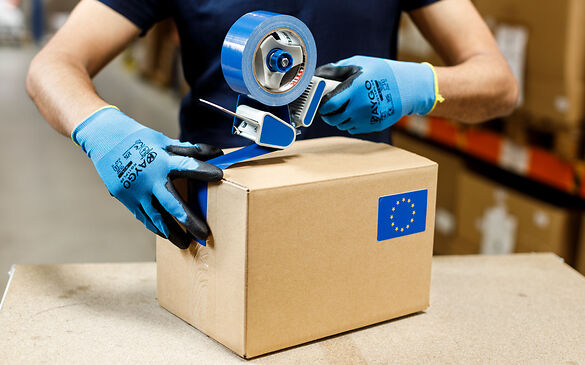
Key objectives of the PPWR include:
For economic operators, the first and most important step is to identify their role and therefore their duties.
Please note: An economic operator can hold multiple roles simultaneously, e.g. manufacturer and producer.
Our white paper gives you a clear overview of the various requirements and roles defined by the EU Packaging and Packaging Waste Regulation. Request your free copy today!
The PPWR requires companies to invest in environmentally friendly materials, smart designs and the establishment of end-to-end compliance processes. Early movers stand to secure market access, minimise risks and position themselves as sustainability champions.
Please note: Only some of the PPWR requirements must be met by 12 August 2026. We have summarised the most important points here.

Deadline: First duties to be fulfilled by 12 August 2026
Who is affected? Manufacturers; distributors and importers must ensure required documentation is in place
Key points:
For further details, see: PPWR documentation
How can Interzero help out? To simplify the conformity process, Interzero has created its Check for Recycling tool. You can use this online service to manage your packaging, have your packaging assessed and create declarations of conformity.
Is important information for your packaging missing? Do you need to optimise your packaging? Our packaging experts will be happy to help and provide you with targeted recommendations for action as part of a packaging optimisation service.
Deadline: The PPWR keeps EPR duties in place and has improved their harmonisation within the EU. In the future, fees paid under EPR will increasingly be eco-modulated to reflect packaging recyclability.
Who is affected? The ‘producer’ referred to by EPR can potentially be the manufacturer, importer or distributor. These operators must fulfil their applicable national EPR duties, which include registration, system participation (or financing of packaging disposal) and quantity declarations.
Key points:
How can Interzero help out?
Interzero organises packaging licensing across Europe and can advise you on all EPR topics. Our digital Lizenzero service is the ideal solution for small- to medium-sized volumes.

Deadline: New limits on PFAS in food contact packaging apply from 12 August 2026; further requirements to follow
Who is affected? Suppliers must provide the basic material data. Manufacturers must specify compliance with limits, etc. in PPWR documentation and make this documentation available to distributors and importers
Key points:
For further details, see: PPWR and chemicals
How can Interzero help out? If you need help with the analysis of your packaging materials or have questions on PFAS, REACH, etc., our internationally accredited Centre of Competence is the right point of contact.
Deadline: from 12 August 2026: Basic principle of minimising environmental impacts from packaging; specific measures must be implemented by 2030
Who is affected? Manufacturer bears primary responsibility
Key points:
How can Interzero help out? Interzero maintains an in-house laboratory that covers the entire spectrum of packaging optimisation processes – from packaging analysis and the assessment of recyclability to packaging development services. Training is also available on request. Please get in touch!
Deadline: Minimum recycled-content requirements from 2030
Who is affected? Manufacturers must demonstrate compliance with percentages; material suppliers must provide manufacturers with data about recycled-content percentages; producers must process recycled content.
Key points:
How can Interzero help out? Interzero can provide companies with recyclates from its own facilities and offers comprehensive advice on the topic.
Our full-length white paper on the study ‘Circular Packaging 2030 – Strategies addressing PCR scarcity’ includes detailed market figures and recommendations for action, and is available as a free download.
Deadline:
Who is affected? Both manufacturers and importers must be unambiguously identifiable
Key points:
How can Interzero support you? Our packaging experts will be happy to offer their support for the the design of your packaging.

Deadline: from 12 August 2026: Avoidance of outsized packaging without a technical function; specific requirements from 2030
Who is affected? Primary responsibility is borne by the manufacturer, who must demonstrably reduce the use of material.
Key points:
How can Interzero help out? Our packaging experts can use a packaging analysis to discover weaknesses and then work with your team to develop legally compliant packaging.
Deadline: Binding requirements for compostable packaging from 12 August 2028
Who is affected? Manufacturer bears primary responsibility
Key points:
Deadline: Binding re-use targets from 2030 onwards
Who is affected? Manufacturers who design and produce packaging; other parties such as suppliers and operators of re-use systems must also be involved.
Key content:
The PPWR is generally applicable to all packaging that is placed on the EU market – regardless of its materials, the individual industry, or whether the packaging is empty or filled. This includes sales packaging, secondary and transport packaging, e-commerce and service packaging, and primary production packaging. All materials are affected (plastics, paper/cardboard, glass, metal, wood, etc.), although individual PPWR requirements only apply to certain materials.
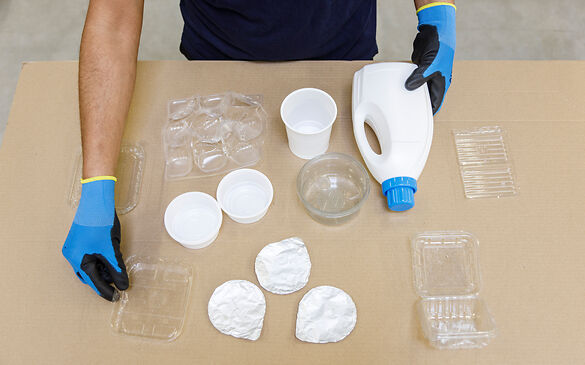
Key packaging types affected are:
Please note: There are very few exceptions or exemptions from individual duties (and never the PPWR as a whole). Some examples include the healthcare sector, or packaging with special hygiene or safety requirements.
Failing to implement PPWR requirements entails significant risks. The PPWR is an EU Regulation and its provisions therefore apply directly to operators in all member states. Enforcement of the Regulation (fines, penalties, etc.) is carried out by the national authorities, who define the corresponding rules and penalty schemes.
Possible actions:

Companies should act promptly, regardless of industry or packaging type:
Our team is ready to advise and assist - get in touch today!
Need assistance for the fulfilment of your legal duties and looking for practical solutions? For over 35 years, Interzero has been an experienced partner for sustainability and the circular economy for customers worldwide. Benefit from our comprehensive expertise and extensive network, and rely on our competent team of experts to answer all of your PPWR questions. Contact us today – we’re at your service!


Consulting Expert
The EU Packaging and Packaging Waste Regulation (PPWR) applies to packaging that is placed on the market within the EU. This means all packaging manufactured within the European Union or imported into the EU from third countries.
The PPWR entered into force at the beginning of 2025. Most of its provisions have been applicable since 12 August 2026. Phased transition periods up to 2030 and beyond apply to individual requirements – such as recyclability, recycled-content percentages or reusability targets.
The Regulation affects almost all companies that manufacture, import, fill or distribute packaging, or are the first to place it on the EU market. These include producers, dealers, importers, e-commerce companies and brand owners.
Yes, in many cases. Companies should check to confirm that their packaging fulfils future PPWR requirements in terms of recyclability, use of materials, labelling and documentation. Prompt analysis now will help to avoid costs for modification later.
Huge amount of packaging waste: Figures from the European Commission show that about 180 kg of packaging waste is produced per person, per year on average, and most of this waste consists of virgin materials. Some 40 percent of all plastics and 50 percent of all paper is used for packaging within the EU, with a 19 percent rise forecast here by 2030 if no countermeasures are introduced. The PPWR therefore aims to reduce this consumption while promoting the circular economy.
Inconsistent legislation and approaches: At national level, there are a great many approaches and regulations in force across the EU at the moment for the collection, reduction and recycling of packaging. Some countries are leading the way while others play catch-up, especially in terms of recycling rates. International producers and traders are faced with the never-ending challenge of knowing the specific regulations in each country and acting accordingly. The same is true for domestic e-commerce businesses who ship to other EU countries. Article 1 of the new Regulation defines the objective to both improve and harmonise the legal situation in the individual member states. We’ll be happy to advise you if you export products to other European countries and have questions about the EU Packaging and Packaging Waste Regulation.
In the future, packaging must be designed to ensure that it can be collected, sorted and recycled efficiently. Combinations of materials that make recycling more difficult are to be reduced. Companies should therefore review their packaging in good time to confirm its recyclability.
Companies can reduce legal risks, design packaging to be fit for the future, and plan the necessary changes in product design and procurement well in advance of compliance deadlines. In many cases, this also avoids the costs involved in later changeovers.