Authorised organisation for producer responsibility
Battery manufacturers are legally obliged to organise and finance the collection and environmentally sound recycling of used batteries.
As an authorised producer responsibility organisation (PRO) for starter, industrial and electric vehicle batteries, Interzero Circular Solutions Germany GmbH undertakes these tasks on behalf of manufacturers, importers and distributors, ensuring that legal obligations are fulfilled in accordance with the law.
What is a producer responsibility organisation?
A producer responsibility organisation (PRO) is a body that undertakes key extended producer responsibility tasks on behalf of producers. By joining a PRO, producers fulfil their legal obligations.
As an authorised organisation for producer responsibility for industrial, starter and electric vehicle batteries, we support manufacturers, importers and distributors in the timely implementation of the EPR requirements of the regulation, thereby significantly reducing the administrative burden:
- Ensuring the take-back of waste batteries
- Compliance with mandatory collection and recycling targets
- Regular volume reporting
- Documentation of material flows
- Advice on labelling and information requirements
Do you wish to supply to Germany but do not have a branch here? We act as your authorised representative in accordance with legal requirements – from registration through to the ongoing fulfilment of manufacturer obligations. This ensures that your batteries can be marketed on the German market in full compliance with the law.
Take-back obligation for retailers and distributors
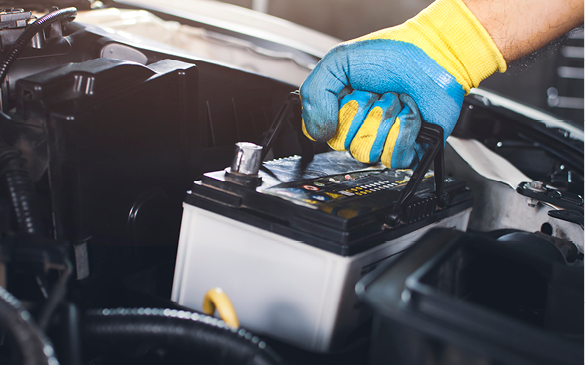
The Battery Implementation Act (BattDG) requires distributors of batteries and accumulators to take these back free of charge at the end of their useful life at their retail premises or in the immediate vicinity – even without a new purchase – and to hand them over to an authorised collection organisation. This also applies to mail-order companies, provided that they offer customers a return option within a reasonable distance. The take-back obligation applies to typical household quantities and to those batteries that were included in the product range.
The advantage with Interzero
For device and low-voltage batteries, we offer online retailers a tailor-made solution – through a combination of a reliable, nationwide network of collection points that are within a reasonable distance for their customers and easily accessible. Returns are handled locally and practically – with no need for postal dispatch. We organise proper disposal and recycling, and online retailers benefit from predictable costs (flat-rate fees) for using the collection point network.
Who monitors the PROs?
The BattDG stipulates that the ear Foundation plays a central role: it authorises organisations to act as producer responsibility organisations and monitors whether these organisations fulfil their obligations.
In addition, the Federal Environment Agency monitors compliance with the quantity and reporting requirements.
Duties to provide information and notify
As a producer responsibility organisation, we are making the following information about the structure and operation of our system publicly available in accordance with Section 11(6) of the Battery and Accumulator Act (BattDG). This transparency serves the interests of producers, public authorities and the general public.
Ownership and membership structure
PRO Interzero Circular Solutions Germany GmbH is a company within the Interzero Group and is indirectly owned by Interzero Holding GmbH & Co. KG. The majority stake in the Interzero Group is held by the group of companies owned by shareholder Dr Axel Schweitzer.
The current membership status of our Organisation for Producer Responsibility (PRO) is available for transparent viewing at any time. You can find up-to-date information in the official register of the ear Foundation.
Financial contributions from members
The financial contributions made by members are calculated on the basis of the quantities of batteries placed on the market (in units or by weight) and depend on various factors, in particular the actual take-back and disposal costs incurred.
A reliable indication of the specific contribution amount per unit placed on the market is only possible after the end of a full financial year, as return rates in particular have a significant influence on the cost structure.
For reasons of protecting sensitive company and calculation data, the figures are published in aggregated form.
Collection rates, recycling efficiencies and rates for material recycling
The relevant key figures on collection rates, recycling efficiencies and material recycling are generally calculated on the basis of a completed financial year and can therefore only be reliably reported once that year has ended.
Our PRO is currently still in consultation with contracted recovery and recycling partners regarding the collection and validation of the relevant data. As soon as reliable information becomes available, it will be published accordingly.
Performance review
The results of the performance review will be published in accordance with Section 26 of the BattDG following their submission to the Federal Environment Agency.
The results will be published within one month of submission and will be made available here on our website as soon as the relevant analyses are available.
Information for end users
As a PRO, we raise consumer awareness, in accordance with Section 25 of the German Battery Act (BattDG), regarding the correct disposal of used batteries. As part of this obligation, we are running a campaign to actively inform end-users about collection points and the importance of separate collection.
End users play a key role in protecting the environment and conserving resources when it comes to the use of batteries.
Waste prevention and extending the life cycle
End users can help reduce waste by using batteries responsibly. This includes, in particular, using them correctly, avoiding deep discharge and using suitable chargers. In addition, there are opportunities for reusing, preparing for reuse, repurposing and reconditioning batteries in order to extend their life cycle.
Ways to prepare used batteries for reuse
Used batteries can be prepared for reuse, provided this is technically feasible and safe. This involves, in particular, testing, cleaning or refurbishing suitable batteries. The aim is to keep functional batteries in use for as long as possible, thereby conserving resources and reducing waste.
Separate collection of used batteries
End users are required to dispose of used batteries separately from unsorted household waste. Separate collection enables environmentally sound treatment and recycling.
Return and collection options
Used batteries can be handed in free of charge at the designated return and collection points. These include, in particular, retail outlets, local authority collection points for starter and industrial batteries (where these are offered on a voluntary basis), and other authorised return points. The collected batteries are then properly prepared for reuse, repurposing or treatment.
Depending on the type of battery (e.g. equipment, starter, industrial or vehicle batteries for electric vehicles), different return channels may apply:
- Starter batteries (e.g. car batteries)
When purchasing a new starter battery from a retailer, a deposit is usually charged unless an old battery is returned. This deposit is refunded when a used starter battery is returned. Alternatively, starter batteries can also be handed in at suitable collection points. If the battery is still in an end-of-life vehicle, it may remain in the vehicle provided that the vehicle is handed over to a certified end-of-life vehicle recycler. The recycler is obliged to remove the battery and ensure it is properly recycled. - Industrial batteries
Industrial batteries, such as those used in commercial applications, emergency power systems or photovoltaic installations, are usually disposed of via specialised take-back schemes. End users should contact the manufacturer, the distributor or the relevant collection points to ensure that the batteries are disposed of properly. - Electric vehicle batteries
Batteries from electric and hybrid vehicles are subject to specific requirements due to their size and technical characteristics. They are usually returned via car dealerships, authorised garages or specialist waste management companies. Improper handling must be avoided at all costs. - Portable batteries
Batteries from appliances (e.g. from household appliances, electronic devices or tools) can usually be conveniently returned via collection boxes in shops or at local collection points.
Safety instructions for handling used batteries
Safety precautions must be observed when handling used batteries. Lithium-containing batteries, in particular, can pose a fire risk if handled incorrectly. Batteries should not be damaged, opened or exposed to extreme temperatures. If necessary, the terminals should be protected against short circuits (e.g. by covering them with tape).
Meaning of labels and symbols
The labels and symbols on batteries provide important information on how to dispose of them correctly. Of particular relevance is the crossed-out wheelie bin symbol, which indicates that the battery must be disposed of separately. Other labels may draw attention to any hazardous substances contained within the battery or to specific disposal requirements, thereby helping to ensure safe and environmentally sound disposal.
Impact on the environment and health
Batteries may contain substances that, if disposed of improperly, can have a negative impact on the environment and human health. Proper return and recycling help to minimise these risks and recover valuable raw materials.


Circular Solutions
Concept of the circular economy leads to sustainable growth