Proven sustainability: Interzero customers receive ‘resources SAVED’ certificates

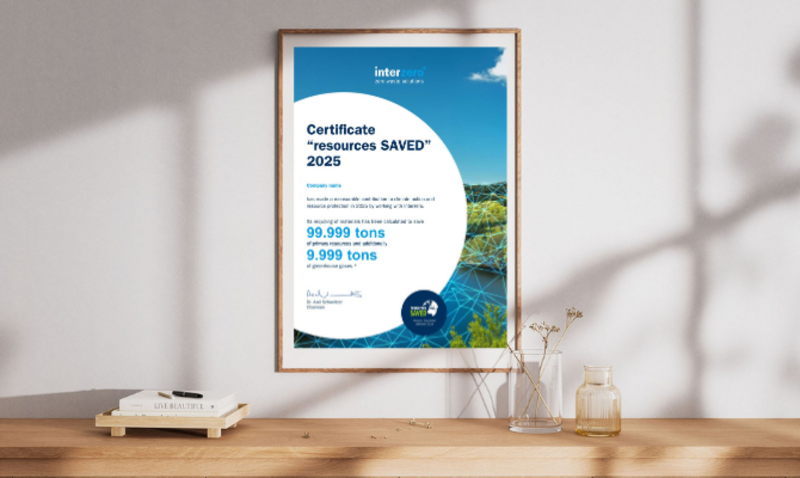
Reliable data is essential to illustrate the environmental benefits of recycling – both on a global scale and for individual businesses. For the past 18 years, Interzero’s "resources SAVED by recycling" study has provided full transparency. Conducted regularly in partnership with the renowned Fraunhofer UMSICHT research institute, the life cycle assessment precisely quantifies how many resources and greenhouse gas emissions Interzero and its customers save together. An additional benefit for the companies involved is that their individual contribution is also calculated precisely on the basis of the scientific study. Once a year, Interzero provides each customer with a personalised "resources SAVED" certificate free of charge. Supplementary downloadable graphics make it easier for companies to communicate their sustainability performance.
Valuable proof of sustainability commitment
For many Interzero customers, scientifically robust evidence of impact is a key component of sustainability communications – and a powerful competitive advantage. Uwe Brandt, CFO of Hörmann KG Verkaufsgesellschaft, comments: "With Interzero, we are conserving the Earth's natural resources and actively protecting the climate." By recycling transport packaging, the leading supplier of gates, doors, frames and operators, working together with Interzero, saved a total of 13,742 tonnes of primary resources and avoided 1,749 tonnes of climate-damaging greenhouse gas emissions in 2025.
Sopro Bauchemie GmbH also relies on the services of Interzero to keep valuable materials in circulation. Through a comprehensive recycling cooperation, the construction chemicals manufacturer not only fulfils all its obligations under the Packaging Act, but also improves its ecological footprint, saving several thousand tonnes of raw materials and CO2 each year. At the same time, it can clearly demonstrate its own contribution to climate and resource protection. Jens Schuchmann, Managing Director of Sopro Bauchemie GmbH, adds: "The 'resources SAVED' certificate confirms the environmental benefits of our partnership – and shows that we are on the right path."
Recognised scientific methodology
The study findings of Interzero and Fraunhofer UMSICHT are based on the internationally recognised Life Cycle Assessment (LCA) methodology. This approach compares every stage of primary raw material extraction with the corresponding recycling processes. The researchers use Interzero’s own data, including recycling volumes, transport distances and the energy consumption of sorting and processing plants, alongside data from Sphera’s LCA for Experts databases. These databases contain validated figures on greenhouse gas emissions and raw material inputs generated during the production of virgin material – for plastics, for example, this includes oil extraction, transport and processing. The comparison shows that recycling offers significant advantages when it comes to protecting our planet.