Interzero x Fraunhofer UMSICHT: Quantifying the Environmental Benefits of Recycling


The annual “resources SAVED by recycling” study makes it clear: recycling significantly reduces environmental impact and plays a vital role in conserving raw materials. Reliable data is key to demonstrating the benefits of recycling and advancing the shift towards a circular economy. That’s why Interzero teams up with the Fraunhofer Institute for Environmental, Safety, and Energy Technology UMSICHT each year to produce a comprehensive life cycle assessment. This allows for precise measurement of resource savings and greenhouse gas reductions.
So, what are the results? In 2024 alone, by keeping around 1.94 million tonnes of materials in the loop across Germany, Austria, Poland, Italy, and Slovenia, Interzero saved 8.09 million tonnes of primary resources. Their recycling efforts also prevented 1.04 million tonnes of greenhouse gas emissions.
For 18 years, Interzero and Fraunhofer UMSICHT experts have been analyzing how Interzero’s recycling activities impact resource consumption and to what extent closing material loops helps cut climate-damaging emissions.
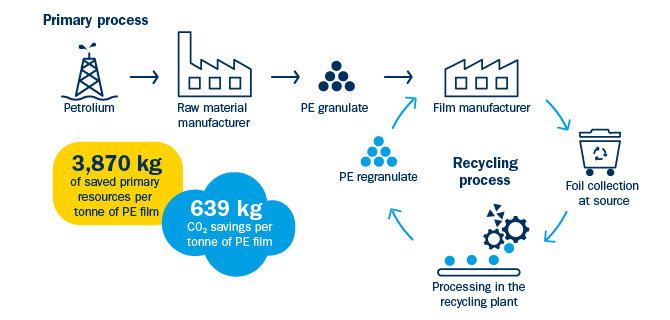
Primary vs. Recycling Process: The Example of Polyethylene Film (PE)
To quantify these savings, Fraunhofer UMSICHT has developed a dedicated four-step methodology:
- The expert team closely examines each individual material stream. For example, with polyethylene (PE), they consider every stage of production—from crude oil extraction, transport to the refinery, distillation, and polymerization. The same thorough approach is applied to Interzero’s recycling process, tracking each step from the collection of used plastics through sorting and processing, to shredding and remelting in the extruder to create PE regranulate.
- Next, resource and energy consumption is calculated for every process step and entered into Sphera’s GaBi life cycle assessment system. This analysis is performed for both approaches: production from virgin raw materials and production from recycled materials.
- Using the collected data, the team determines the amount of raw materials used and greenhouse gases emitted in both the primary and recycling processes.
- Finally, these values are compared. The difference reveals the precise environmental benefit for each material stream.
The difference reveals the precise environmental benefit for each material stream.
Year after year, the results clearly demonstrate that the positive environmental impact of the circular economy is tangible and measurable—not only for Interzero, but also for our customers and partners. Each Interzero customer can verify their individual contribution annually through a personalized certificate. The “resources SAVED” certificate details the reductions in primary raw materials and greenhouse gas emissions achieved, providing transparent and credible documentation of customers’ improved environmental footprint.